

By Konstantinos M. Kokkinoplitis*
At a recent workshop in Brussels regarding the management of EU funds, the room—suffocatingly packed with executives and officials from the 27 member states—accurately depicted the European administrative microcosm. Presentations filled with terminology and compliance followed one another in succession. The discussion, conducted in a language of technical terms and regulatory jargon, revolved exclusively around procedures, paragraphs, and articles. It was an event of pure legalism, with almost no substantive reference to the result, the social or economic impact, or the meaning of the endeavor itself. A living proof of the European fixation of form over substance. Where others build with determination, Europe stops with diligence. A continent that fears action more than it fears error.
This example becomes clearer when compared to the other side of the world. In his book Breakneck: China’s Quest to Engineer the Future, Dan Wang (2025) captures with impressive clarity the deep cultural dimension of the rivalry between China and the United States: legal culture versus engineering logic. China appears as an administrative machine run by engineers who perceive the logic of matter and production—staffed by engineers, people who understand physics, mathematics, and the logic of a world that produces things. A state where technocrats in power treat society like a project with a beginning and an end; something that can be designed, corrected, and reconstructed. A China that builds its future around engineers.
In contrast, the US operates through a culture of regulatory management, where progress is regulated by committees, permits, and interpretations of laws.
Wang neither praises nor condemns. He shows that the technocratic speed of China and the regulatory immobility of America are two sides of the same dilemma. Progress is ultimately determined by the balance between the engineer who builds and the lawyer who permits.
With examples such as high-speed railways, the skyscrapers of Shenzhen, and the knowledge networks of Chinese industry, the book reveals something deeper: that our century will not belong to those who imagine the future, but to those who construct it.
The answer is not to imitate. We must not blindly copy the technocratic strictness, centralization, and limited institutional accountability of China, but rather regain our creative confidence within the framework of our democratic institutions.
From Chinese technological confidence, we pass to the European insecurity of the rule—a continent that seems to have forgotten its own creative boldness. From the obsession with the legal aspect to the bureaucratic paralysis of Brussels, the continent of rules has cut itself off from action.
What efficiency can we speak of when our only concern is the formality of a procedure, and not whether the result is moving in the right direction? Europe legislates, inspects, and complies. It does not build, it does not innovate, it does not risk.
A characteristic example is the European Hydrogen Strategy, which began with ambitious goals for the energy transition but has become trapped in licensing procedures and regulatory filters. Hydrogen projects are delayed not due to technological difficulties, but due to regulatory fatigue. The experiment is lost in the approval.
Once, Europeans saw the world as a challenge to conquer; now they see it as a violation to correct. Productive imagination has been replaced by legal correctness. In committees and ministries, the prevailing doctrine is "let no mistake happen," not "let it be done right." Engineers, the people of matter and action, are lost in forms, tenders, and compliance reports.
The result is projects that are delayed, investments that are postponed, and technologies that are lost before they are tested. A continent that no longer trusts its creative power. A Europe that does not construct, but interprets. That does not experiment, but inspects. That instead of preparing for the future, legislates it line by line.
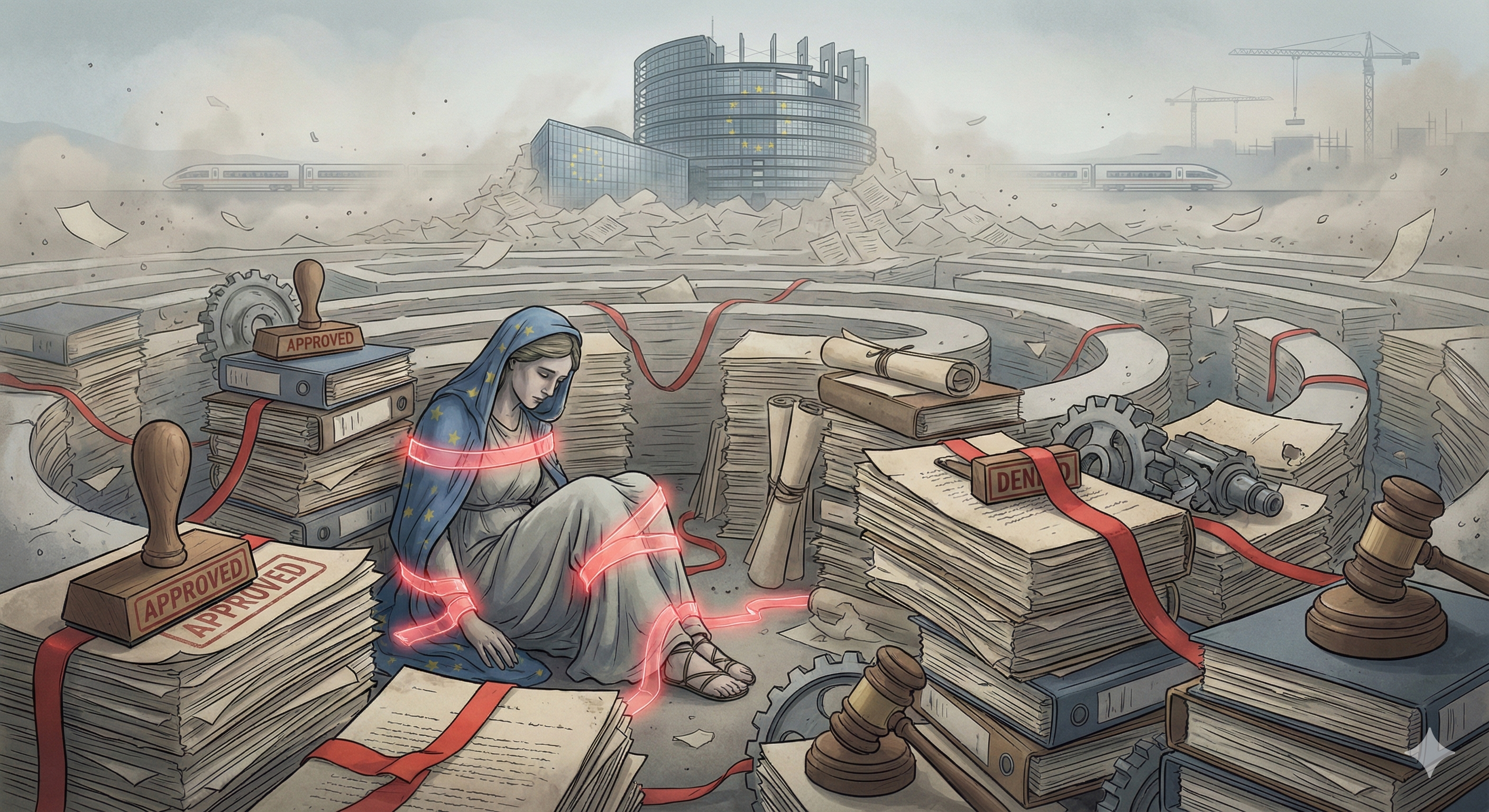
The institutional labyrinth. An apt metaphor for how legal rigidity and over-regulation have woven Europe into a complex web of rules. In the name of transparency, Europe has turned into an institutional maze. The average European official is a lawyer or political scientist. Europe is governed by lawyers, not creators.
In China, more than 40% of university graduates belong to STEM fields; in Europe, it is about 22%. The engineer’s doctrine—"test, build, iterate"—has been replaced by the lawyer’s doctrine—"consult, review, approve." Thus speed, boldness, and imagination are lost. The very essence of innovation.
Those participating in competitive European programs like Horizon Europe and Digital Europe painfully realize that creativity is stifled by forms and approvals, innovation by Excel spreadsheets.
From the energy transition to public procurement, regulatory fetishism prevails. The belief that every problem is solved with a new regulation.
If Europe suffers from institutional complexity, Greece lives its excess. Here, legalism is not a trend; it is a way of life. From a building permit to a research expenditure, every step turns into a bureaucratic odyssey.
An engineer devotes more time to interpreting decrees than to designing. Every urban planning case feels like a PhD in law. Armies of lawyers produce bureaucracy with confidence and pomp, while the citizen's daily life remains stagnant.
According to the European Investment Bank (EIB Investment Survey 2024 – Greece Overview), 63% of Greek businesses employ staff exclusively for understanding legislation. Since 1975, the country has issued over 5,000 laws and 21,000 Presidential Decrees, with more than 75,000 pages of legislation annually.
And an image that says it all: 83 lawyers in Parliament, 40 doctors, and just 25 engineers. A Parliament that resembles a courtroom more than a decision-making space—with the doctors trying to keep it in intensive care.
The price of immobility: lost competitiveness, technological decline. Europe slows down, watching others innovate.
Before we continue to a more philosophical level, it is worth remembering how a thinker who spares no one describes it. Nassim Nicholas Taleb summarizes the European drama: "Business leads to technology, and technology leads to science — through trial and error. The minute you formalize a system, the bureaucrats take over — no longer the inventors."
Instead of experimentation, processes. Instead of risk, compliance. Instead of creation, fear. Europe thinks it reduces risk by limiting volatility; in reality, it eliminates the possibility of evolution.
The Green Deal and the Digital Transition promise sovereignty without an industrial base. Europe pioneers laws on Artificial Intelligence, but not Artificial Intelligence itself. We export standards; we import technologies.
The rule of law was and remains one of the foundations of European democracy. European legality ensures rights, limits arbitrariness, and creates predictability. The issue, of course, is not to abandon the rules, but to subordinate them to action; to move from "let no mistake happen" to "let it be done right."
The answer is not to imitate the technocratic strictness of China; it is to regain our creative confidence within our democratic institutions.
Europe must become the engineer of its own future again. If we want our continent to once again be a continent of creators, it must first believe in the power of action. It does not need more laws; it needs people who create. Engineers, scientists, inventors who believe that the world changes through experiment, not through the Government Gazette.
Perhaps this is the price of the European dream that once united peoples and is now lost behind the letter of the law. Because the future will not be written by those who know how to legislate, but by those who know how to build.
This article was first published in capital.gr on 2025/11/07.
References:
- UNESCO Institute for Statistics (2023), STEM graduates per country.
- OECD, Education at a Glance 2023, Table B4.3: Share of graduates in technical and scientific disciplines.
- Eurostat (2023), Science and Technology Graduates by Field of Study.
- European Commission, Human Resources Report 2022.
- Bruegel (2021), Who Governs Europe? Composition and Expertise in EU Institutions.
- European Investment Bank (2024), EIB Investment Survey 2024 – Greece Overview.
- Βουλή των Ελλήνων (2024), Parliamentary Composition Statistics
* Mr. Konstantinos Kokkinoplitis is a director of Seven Sigma P.C. and RISE and former Secretary General of Research and Technology.
Add new comment